What pruning can fix
- Dead, diseased or broken branches.
- Limbs against the roof, the gutters or a wall, or low over a driveway.
- A long, heavy limb over a weak fork, where taking weight off lowers the strain.
- Branches growing toward a service line.
The ISA’s rule for every cut is worth repeating to a crew: removing a live branch leaves a lasting wound, so no branch should come off without a reason. Correct cuts are made just outside the branch collar, the slight swelling where a branch joins the trunk, not flush and not leaving a stub.
What it cannot fix
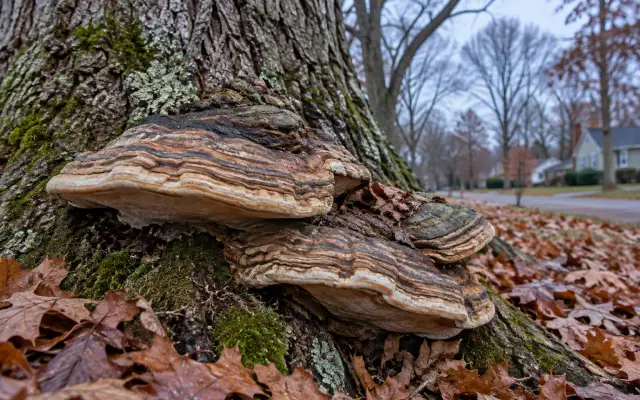
A tree in decline, decay through the main trunk, roots that have let go. Then the choice is support or removal. Should it come down?
Why topping is the wrong answer
Cutting a tree’s top back to stubs to make it shorter is the most common bad request. The ISA explains why it backfires: topping can strip half or more of the leaf-bearing crown and starve the tree; the shoots that sprout below each cut are attached only in the outer layers of the wood and grow fast; and those shoots break easily in wind and ice. A topped tree ends up more likely to drop limbs, not less, and the large open wounds decay. If a tree is too big for its spot, the honest options are removal or careful reduction to suitable side branches.
Near the lines
Utilities prune around many of their own lines on a schedule; the ISA notes that most systematically prune vegetation away from uninsulated lines. Anything within reach of a line is the utility’s or a line-clearance crew’s job. Tree on power lines
Checked against the sources below on 2026-10-11.
 What are the warning signs a tree may fail?